Saturday, January 22, 2011

International Communist Solidarity Prorest Against for World Economic Forum


A protest against the World Economic Forum was held in St Gallen, Switzerland on 22. 91. 2011 by many polotical parties and groups under the Red flags.


Alle Jahre wieder findet im Landwassertal, genauer gesagt in Davos, das World Economic Forum (WEF) statt. Auch in diesem Jahr lädt der Ziehvater des WEF, Klaus Schwab, die selbsternannten Wirtschaftskapitäne, Ministerpräsidenten und Young Global Leaders nach Davos ein. Das 41. Annual Meeting des World Economic Forums (WEF) findet vom 26. bis 30. Januar unter dem Motto "Shared Norms for the New Reality" statt.

Der Widerstand gegen das WEF äussert sich auch in diesem Jahr in verschiedenen Formen. Mit dem Ziel "Lassen wir uns nicht spalten" gehen wir dieses Jahr auf die Strasse.

Für Interessierte gibt es neben den Demonstrationen am 22.01.2011 in St. Gallen (14 Uhr Bahnhofplatz) und am 29.01.2011 in Davos auch viele verschiedene Veranstaltungen in der ganzen Schweiz.


Tuesday, December 7, 2010

Political activists and journalists attacked at airport

Supporters of the General Secretary of the Nava Sama Samaja Party (NSSP), Vickramabahu Karunaratne and some journalists were attacked at the Colombo airport by a mob while the police were looking on.

Dr. Vickramabahu Karunaratne

MTV Katunayaka correspondant Prema Lal and Lankaenews journalist Shantha Wijesuriya who went to cover Dr. Vickramabahu Karunaratna's arrival from the UK have been assaulted.

Activists attacked

NSSP party members, Journalists, trade union leaders, lawyers and human rights activists were among the victims of the attack.

Dr. Vickramabahu Karunaratna who returned to Sri Lanka after a visit to the UK accuse deputy minister for ports and aviation Sarath Kumara Gunaratne for organising the attack.

During his visit, the NSSP General Secretary addressed several public meetings. He was one of the main speakers at the Tamil remembrance day 2010 held on 27th of November.

Bahu to be investigated

The government of Sri Lanka has accused Dr. Karunaratne and opposition parliamentarian Dr. Jayalath Jayawardena of organising the protests in London in collusion with Tamil Tiger supporters.

Lakshman Hullugalle, the Director General of Media Centre for National Security who said that it is too early to name suspects alleged that the attack was instigated by people who were discontented by Dr. Karunaratne's anti government activities in the United Kingdom.

"Dr. Jayalath Jayawardhana and Vickramabahu, both will be investigated and will be taken in to custody if necessary for their anti government activities abroad", said Lakshman Hullugalle.

Sri Lankan Govt's Thugs attack to Comrade Bahu and his Supporters- Sri Lankan Airport

Saturday, October 2, 2010

Political Situation in Nepal

[Gaurav, a member of the Central Committee of the leading Maoist party in Nepal, the UCPN(M), gives his thoughts on the current political impasse as it has continued since the 2006 strategic turn (with the Comprehensive Peace Agreement) and the subsequent rise and fall of UCPNM leadership in the process of forming a coalition government. Can this strategy be re-envigorated? Or is a strategic turn now required? His thoughts follow....-ed.]

Red Star. June 2010

Present political situation and policy of the Party

by C P Gajurel ‘Gaurav’

Present political situation is marked by various twists and turns and ups and downs. After the abolition of autocratic monarchy ruling over Nepal since last two and a half centuries, the contradictions of Nepalese are in the process of changing. This change in the contradiction has brought some new changes in political alliances and new conflicts. The political parties which made repeated commitments before the people of Nepal and at the international sphere, proved futile when the tenure of the Constituent Assembly(CA) nearly ended without accomplishing its job of writing a new constitution.

Though the term of CA has been extended for another one year, making new constitution is still a tuff job, because the diff erences among the major political parties remain unresolved and new issues of diff erences have cropped up regarding many questions related and unrelated to the constitution. This article has been prepared based on such political circumstances.

Why the Constituent Assembly?

Though the slogan of Constituent Assembly was first coined by then Nepali Congress during 1950’s when it was leading anti-Rana mass movement, but it was completely left out for the last half a century. Th is slogan was raised by C P N (Maoist), but at the different circumstances. The party identified the existing monarchy as the main obstacle for the development of the Nepalese society and worked out a tactical line of making alliance with all the political forces who wanted to get rid of the monarchy. Major slogan to forge such an alliance was Constituent Assembly.
The slogan of Constituent Assembly was coined by the party in its National Conference held in 2001. Efforts were made to forge alliance with the parliamentary parties. It did not materialize, because the parliamentary parties were moving around the king and vying to get better portfolios in the king’s cabinet. These parties had the policy of making united front with the king and wipe out the Maoists.

The coup staged by king Gyanendra in February 2005, in which he declared emergency and became head of the government, caused a new political situation. Many leaders of the main stream political parties were either imprisoned or under the house arrest. So the parties were compelled to struggle against the monarchy. India, which was main external support to the monarchy to fight against the Maoist led People’s War was not happy with the latest step of the then king directed also against its allies, the parliamentary political parties.

The other point that caused anger to the Indian government was that the Gyanendra regime bought arms with China which India conceived as a challenge to its authority and gross violation of the tradition of making arms deal only with India.

Our party, the CPN(Maoist) using these newly emerged contradictions as opportunity to forge alliance with the parliamentary parties against the monarchy which was the representative institution of feudalism, bureaucratic and comprador capitalists and the party took initiative to achieve this aim. It was thus finally materialized with 12 point agreements between Maoist party and seven parties.

Differences crop up

The autocratic monarchy ruling over Nepal for the last two and a half decades formally came to an end when fi rst meeting of the constituent assembly declared Nepal a Federal Democratic Republic with almost unanimous vote on May 28, 2008.

The king and the parliamentary parties represented the interest of almost the same classes. In absence of the monarchy these parliamentary parties started to play leading role in fulfi lling the interest of these classes which was reflected in all spheres– politics, making alliance, formation of the government etc.

The exploiting classes are always dependent on international forces of their character. In this era of imperialism and proletarian revolution, the exploiting classes such as comprador and bureaucratic capitalists and feudals are dependent on imperialist and expansionist forces or both. In case of Nepal, India is the external power which interferes in Nepal in many areas like—politics, economics, culture, territory etc.

This is the reason why it is considered as expansionism. India’s role as expansionist power has been more expressed during last couple of years. It is known to many people in Nepal that India creates parties, India causes splits in the parties, India makes accesses in parties and makes them unable to implement their own line and plan, India plays determining role in making, sustaining and bringing down governments. Therefore Nepal is considered as a semi-colonial country.

Many agreements, understandings, negotiations have taken place among seven parties versus Maoist party in the past. In the election of constituent assembly held in 2008, the UCPN(Maoist) has emerged as the single largest party securing majority (123 seats out of 240 total seats of the CA) NC and UML have been reduced to second and third ranking parties. All these parties were co travelers during anti-king mass movements. When the monarchy came to an end the political chemistry has been changed. NC and major section of UML represent the interest of comprador, bureaucratic capitalist class and remnants of feudalism. So they are unable to go beyond statusquo.

They are against bringing about fundamental and revolutionary transformation in the society. They collaborate with Indian expansionism and contribute in continuing the semi-colonial character of the country. Thus their role especially aft er the abolition of monarchy has been changed.

Because of the class nature of NC and UML as mentioned above they are bound to confront with the agenda put forward by Maoist party for the qualitative transformation of the Nepalese society. In this way contradiction between Maoist party and mainly with other two parties, NC and UML is sure to come up. In course of time this contradiction can even be sharper in the future.

Practice of the last two years has clearly indicated that the NC and major portion of UML are not going to soften their stand, they are trying to harden their stand against Maoist. Th eir collaboration with Indian state is further deepening and they are taking more antinational stands.

Contradictions in a process of changing

During the period of monarchy also the Nepalese society was characterized as semi-feudal and semi-colonial. Our party formulated that the principal contradiction of the Nepalese society was between feudalism, bureaucratic and comprador capitalism supported and backed by Indian expansionism versus the Nepalese masses. Feudalism was the principal aspect, because monarchy represented institution of medieval feudal society.

In the question of safeguarding the national interest of the country, the kings always tried to use the question of nationalism or patriotism as a mask to cover their anti-people character and autocratic rule. It was impossible to safeguard Nepal’s national interest or nationalism under the rule of a king, because there are several instances in history in which kings have surrendered in front of the foreign powers and lost the sovereignty of the nation. Sugauli Treaty is one of the worst examples.

It is also true that if the whole country goes under complete control of foreign power the monarchy would be nowhere. So the nationalism advocated by the king was confi ned to fulfill the interest of monarchy. Abolition of the monarchy which was ruling over Nepal since last 250 years is definitely a historically significant event. It is a victory against feudalism.

This historic event is sure to influence the political situation of the country and also the contradiction of Nepalese society. So far the domestic contradiction is concerned feudalism still exists but it is no more principal aspect. Contradiction against bureaucratic capitalism and comprador bourgeoisie is principal aspect. Thus the domestic contradiction can be defined as –comprador bourgeoisie, bureaucratic capitalism and feudalism versus Nepalese masses.

External intervention in Nepal has increased unabated. Indian expansionism which played supportive role in favour of the ruling class in the past has started to play direct role. It has executed all other forms of intervention except direct military invasion. Thus the contradiction of Nepal and Nepalese people with India is heading to principal contradiction.

The recently held Central Committee of our party has made serious evaluation of the recent development in the contradictions of the Nepalese society and has arrived at a conclusion that the principal contradiction is changing rapidly. At the present situation, the domestic and external contradictions have so intertwined that it is hard to separate. Thus the principal contradiction is heading to– bureaucrat capitalism, comprador bourgeoisie and feudalism and Indian expansionism on the one hand and the Nepal and the Nepalese people on the other.

United front policy

Given the change in the principal contradiction it will have reflection in the policy of making united front, alliance and unity in action with different classes and class forces. Our party is leading mass struggles and mass movement with concrete slogans. Since one year we are putt ing the slogan of National independence at the fore front. It does not mean that the domestic contradiction has ceased to exist.

There is still remnant of feudalism dominating in the society. But feudalism is not the principal aspect. Comprador bourgeoisie and bureaucratic capitalism is becoming the principal aspect. It is quite evident that when the question of National Independence comes at the fore front, it demands that the party should forge the policy of making united front with the patriotic forces.

It shows that the nature of friends and foes has been changed according to the
changed situation. The real patriotic forces have to become the allies of revolution. It is obvious that that when there is change in the principal contradiction, the policy regarding the united front should be changed accordingly. There should be a broad united front among the working class, peasantry, oppressed nationalities and tribes, women and dalits and patriotic forces.

In the given situation of the principal contradiction, the major slogan of the united front is—All the patriotic, left ist and republican forces should unite!

This policy of united front has also been refl ected in making new constitution. Our policy regarding the new constitution is very clear. Nepal should have a constitution of People’s Federal Republic. Only the constitution with such content can address the demands of the oppressed people and all sections of the people of Nepalese society—working class, peasantry, dalits, women, jatis, janajatis and can safeguard the national independence and national sovereignty.

Based on the new line of the united front our party is going to make a concrete tactical line and concrete plan of action. As explained by Mao, line decides everything. The correct line formulated by our party will be definitely able to accomplish the revolution.

August 14, 2010 - Posted by Ka Frank | Nepal, Nepal Party Statements | constituent assembly, CP Gajurel, Gaurav


http://revolutionaryfrontlines.wordpress.com/2010/08/14/cp-gajurel-on-the-political-situation-in-nepal/

Friday, May 14, 2010

War is over. Are you comfortable now?


War is over. Are you comfortable now?- Can you wash your hand

(Under the above title written this article written by Inter University Students Federation is very sensitive and crucial at the time, but it is very controversial ideological approach done by the pro supported JVP Unionist today though is a tragedy as there was no political view with humanist and Marxist philosophy, so they always choose the very cheaper way to get power and to go to the people’s mind.
In that sense they already become the situation of a prostitute and even now don’t understand the reality and round of the Sri Lankan politics.
Finally we here publish this article as an important point in one hand and as a tragedy in the other hand of Sri Lankan leftist representatives)


War is over, war is over, war is over. That is the chant moaned by the government and its associates through the last 11 months. But we would like to ask one question. Is it all right now? Or is it comfortable now? The simple meaning of this is “you think it’s all over after the war is over?" We clearly remind you about one thing. Though the war is over, the problem is not over. It’s in its primary stage, or it is worse than that.
People made many commitments to defeat the separatist terrorist front. All the people from north and south queued up together for that. Tamil people from north left Prabhakaran alone and fled, trusting the government army. At that time the Muslim people from the east trusted the government too. All the Sinhala, Tamil, and Muslim people from the south put up with a bunch of ministers extending to hundreds, their thefts, their rowdyism, with the price of goods, many kinds of defense taxes and also the so called strength of the government doing war. How did the government pay them back? What did the government do for the people who queued up for patriotism, and who thought of the country rather than their tummies.
Now the people of the east sigh as they look at foundation stones and light posts abandoned all over the place. The people of the south watch on television the way the next prince of the Rajapaksha generation is being dressed with kurahan satake by using the votes looted from them by hammering the dead tiger skin.
Today the people of north have been put into misery that cannot be explained in words. They have been made into beggars. They have been made into a situation where they are worse than the dust of the A-9 road.
Take this road….
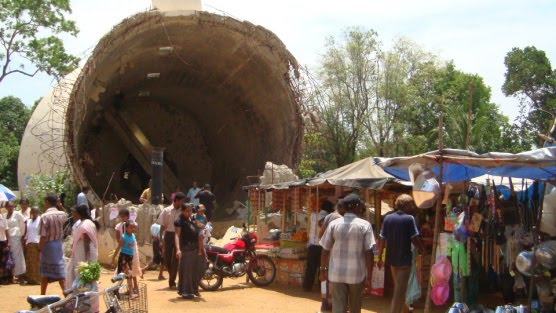
We would like to request you to come walking along the A-9 road consciously if you want to see with your own eyes the sufferings faced by the people of the north. We especially have to refer “consciously”, because we have seen many times the ridiculous things done on trips by people who have been lost because of the synthetic dreams of government, like Uthuru Wasanthe. Our mothers who pose for photographs in many gestures beside the
1
devastated Kilinochchi water tank would not think for a moment that because of the broken water tank, the children in Kilinochchi are without water to drink.
Think of when the female devotees who are overjoyed with Buddha’s enlightenment because of the opportunity to worship Nagadeepaya travelling to Jaffna through A-9 on their noses’ directions, and it would not come to their minds of the 15 year old mothers in the slums on both sides of the road who feed their children of three years with their under-grown breasts.
This is not a fault of our country’s people. This is the result of the hypnotism carried out on the people by the government. The Uthuru Wasanthe is on one side. The train for your hearts is on another side. An advertisement on the North showing massive developments is on one side. The news on the kethumathi reign is on another side. We would like to request from you again to come walking along the A-9 road not in dreams, but in reality. The government boasted of finishing the resettlement of the people in the IDP camps of the north by January in the election times. But all of IDPs who still remain our brotherly people are still suffering in the IDP camps including Settikulam. Their children do not have even the lowest facilities needed to study. And also many schools haven’t been opened. Or they are used as school IDPs. And also the devastated schools haven’t been built yet. And they are also used as schools for rehabilitation camps.
As an example, Periyakulam college of Kanagarayankulam is still a collection of four white walls. It hasn’t been built. And also Omanthai central college is still a rehabilitation centre rehabilitating LTTE suspects. Therefore school children have to study in the nearby slums made with coconut branches.
2
The Periyankulam college of Kanagarayam Kulam still only has four walls.
The students of Omanthai central college who study under trees and slums of coconut branches for a year because of their schools have been maintained as rehabilitation camp.
Re orphaning alias resettlement
Resettlement is a mere bunkum. It is not a resettlement. It is re-orphaning. What the government did as resettlement is to leave the people of slums on the two sides of the road. They are given only 9 corrugated metal sheets and 10 pieces of wood in this so called resettlement. Some houses haven’t been given even that much. They have been given only a tent sheet by the NGOs.
Can you ever imagine the lives spent by these Tamil people in these small huts just like children’s playing huts. No economic mechanism is made related to their families. The protection of the children and women, and their confidentiality are still critical problems. The student called “Krishna” who met us in Kilinochchi said that some person entered into her camp many times in night and ran his hands on her body.
Both mother and child are children
A critical problem in these IDP camps is that many under aged children became mothers. “Sharmila” who we met at Mankulam was 15 years old. She has a daughter aged 2.5 years. Her husband and the father of child is 16 years old.
3
This is not a misery inherited only to her. The reason is that they had been prompted to marry with somebody and make children, to prevent LTTE from taking them to their organization. The reason is pregnant women or women with small children were not taken by the LTTE. The result of this social conflict is visible in front of our eyes. There is a critical need of implementing a brisk mission related to them on education and health. But this problem has not even been identified properly by the government.
IDP camps without rehabilitation.
And also there are many centres introduced as rehabilitating centres of LTTE suspects are in Vaunia. Among them there are Pampalu, Punthottam, Nellukulam, Marambikulam, Vavuniya Muslim College and Omanthai central college. Especially many Tamil children still have been imprisoned in Pampamadu camp for 12 months.
University of Jaffna Government launched a big advertising process during the presidential election that about 1750 students in these camps had been released. But on April 8th, less than 500 had been released. Among them there were few students. Although there were more than 200 students of Jaffna University in the Pampamadu camp, only 43 female students were released. Not even one male student of the Jaffa University was released. Today there are still more than 150 male students who are imprisoned in Pampamadu camp. And no information was even revealed of those students.
The facilities in those camps are below standard. The students were sent to those camps from IDP camps. We asked those students what were the steps taken for rehabilitation in those camps. They said that they were trained to how to make rings using coconut shells. We asked what were the reason for giving training on making rings of coconut shells to people who have bee selected to universities to study commerce, arts, medicine and engineering degrees. The government should explain the rehabilitation coming out of it. Shouldn’t we go against the wrong doing of the government which is imprisoning, wasting and destroying young Tamil lives?
And also there are 12 disabled female students among those female students. Among them some are critically disabled who have lost their hands, legs. But no facility was provided by the university. A building is provided as the only facility to them for their living.
4
But it is strictly forbidden for anybody of them to go outside university premises. They weren’t allowed to go out even on New Year days. Therefore they have been imprisoned in the university in addition to their imprisonment of a year.
Among the female students imprisoned in the Jaffna University, there are female students of other universities. As an example, a female student called “Peter Sathgunarasan Anusha” was chosen for Kelaniya University according to A/Ls. Her course was Peace and Conflict Resolution. But she is in a hostel of Jaffna University. Her course is not conducted in Jaffna University. Likewise there are female students who have been chosen for eastern University and south-east University.
Ranked 2nd in the district but the university is prohibited.
We got to know of better examples of lives of Tamil students being destroyed in this Pampamadu camp. She is Puwanenthitan Thasmida. She faced her A/L in 2009 in maths stream. Results came and she was ranked second in the Mullaitivu district. Therefore she was chosen for the engineering faculty. But she was not allowed to register in the university by the Pampamadu authorities. She is still in her camp.
All the factors show the misery faced by Tamil people. Many Tamil students have become victims of this misery. 5 students have died since the war in Jaffna district. 4 out of them are students of Jaffna University. And three of them died by hanging themselves.
Balasingham Karunanidhi who committed suicide on 2010/04/02 was a third year student of the management faculty of Jaffna University. The reason for his death was the harassment faced by him in the past wartime and after wartime. He and his nine family members had been suffering for months in IDPs and in those camps; Balasingham was not treated for his illnesses. After that he came back to Jaffna University and was not treated. And also his nine family members spent a worse life. All of them had been given only 07 tin roof sheets. That pressure affected them too. The last result was his death by hanging himself.
A male student of the management faculty of Jaffna University Ravindradasan Victor Aruldas and a female student called Velayandan Piruwali jumped to Kopali lagoon and suicide on February 10th. They were lovers. Ravindradasan was shot in the wartime and had a neural illness. But he was not given any treatment. At last they wrote letters and commit suicide themselves together.
And also Tiruchelvam Kapilanath of Jaffna was abducted for a ransom of 30 millions and killed on 14th of March. An LTTE cadre of Jaffna has been accused for that. And also three months ago a female student of Jaffna University died having Dengue flu. These suicides show the pressure faced by north and east Tamil people today. They happened because of the pressures got critical more than they could bear. The government should be responsible for this. These show that the government does not care about the Tamil people. And also about 10000 Tamil people are still detained in government prisons as political prisoners. It is a critical situation and also about 140 Tamil students in Jaffna and east universities have
5
6
vanished. That is since the war but the government doesn’t reveal any information on that. Because of these conditions, Tamil people have to suffer many pressures. The pressure is so high that some persons choose suicide themselves. Therefore their rights should be given immediately. The development should be taken forward briskly. Devastated schools, buildings, houses, transportation should be restored.
But the government is playing the fool. The former transport minister Dallas Alahapperuma’s frauds like “A ticket to heart” to build a railway track to Jaffna should be stopped. Because they are deceived the Tamil people again.
In the last year minister Dallas couldn’t build a railway any kilometre beyond Vavuniya. The results will be terrible if no brisk intervention is made. The reason is the pressure among Tamil students before the year 1983 ended with a terrible terrorism. The prime minister is talking nonsense of terrorism’s three phase arrival. The youth problems should be solved to prevent youth conflicts from emerging. People’s rights should be given to prevent people’s rise. Therefore to prevent armed conflicts again, the problems of Tamil people should be solved by giving their rights.
Otherwise, the rise of the youth cannot be prevented by accusing all the Tamil youth in the prison camps that they are LTTE terrorists and keeping them in prisons or by addressing false arguments of keeping and curbing laws such as the law of emergency. The people should be given rights. The people should be given democracy. The people should be given freedom. That is the way to build real national harmony.
Udul Premarathne (0777-357124)
Convener, Inter university students’ federation
Email: udulpremarathne@yahoo.com

Friday, April 30, 2010

Great Salute for Nepal Maoist


This may 1th is unavoidable start for Nepal as a one and new step of the revolution. Our comradely saluation for the struggle.Mels


Nepal: Bracing for `high noon' after May 1

By Jed Brandt, Kathmandu
April 21, 2010 — JedBrandt.net —

There are moments when Kathmandu does not feel like a city on the edge of revolution. People go about all the normal business of life. Venders sell vegetables, nail clippers and bootleg Bollywood films from the dirt, cramping the already crowded streets. Uniformed kids tumble out of schools with neat ties in the hot weather. Municipal police loiter at the intersections while traffic ignores them, their armed counterparts patrol in platoons through the city with wood-stocked rifles and dust masks as they have for years. New slogans are painted over the old, almost all in Maoist red. Daily blackouts and dry-season water shortages are normal for Nepal’s primitive infrastructure, not the sign of crisis. Revolutions don’t happen outside of life, like an asteroid from space – but from right up the middle, out of the people themselves.
Passing through Kathmandu’s Trichandra college campus after meeting with students in a nearby media program, I walked into the aftermath of bloody attack. Thugs allied with the Nepali Congress party student group had cut up leaders of a rival student group with khukuri knives leaving one in critical condition. Hundreds of technical students were clustered in the street when I arrived by chance. The conflict most often described through the positioning of political leaders is breaking out everywhere.
Indefinite bandhs [strikes] are paralysing large parts of the country after the arrest of Young Communist League (YCL) cadre in the isolated far west and Maoist student leaders in Pokhora, the central gateway to the Annapurna mountain range. The southern Terai is in chaos, with several power centres competing and basic security has broken down; banditry, extortion and kidnapping are now endemic. Government ministers cannot appear anywhere without Maoist pickets waving black flags and throwing rocks.
With no central authority, all sides are claiming the ground they stand on and preparing their base. It’s messy, confused and coming to a sharp point as the May 28 deadline for a new constitution draws near with no consensus in sight. The weak government holding court in the Constituent Assembly can’t command a majority, not even of their own parties. Seventy assembly representatives of the status quo Communist Party of Nepal (United Marxist-Leninist) party signed a letter calling on their own leader to step down from the prime minister’s chair to make way for a Unified Communist Party of Nepal (Maoist) -- UCPN (M), known simply as the Maoists -- national-unity government. He refuses, repeating demands that the Maoists dissolve their popular organisations and return lands seized by the people who farm them.
The Maoists have more pressing concerns than the legalism of the parliamentary parties. If they can’t restructure the state, by constitutional means or otherwise, the enthusiasm that brought their revolutionary movement this far may turn to disillusionment. With no progress in the assembly, the leaders of the status quo parties now say there will be no resolution on time. The Maoists have rejected any extension as a stalling tactic and are turning to the people. With now-or-never urgency, they are mobilising all their forces for a decisive showdown in Kathmandu.
Nepal braces for May 1
Posters for May 1 appeared overnight announcing the Maoist call for workers and villagers to converge on Kathmandu for a “final conflict”. The Maoists are calling for a sustained mobilisation, with the hope that an overwhelming showing can push the government out with a minimum of bloodshed and stay the hand of the Nepal army.
May 1 is International Workers' Day, the traditional day of action for communists around the world, but the mobilisation has already begun.
Thousands of recruits are being trained by YCL cadre in districts throughout the country, drilling with bamboo sticks in place of rifles. With threats from Nepal army commanders to put these protests down with force, the Maoists are preparing to defend their mass organisations, the marches, the party and the people from attempts at counter-revolution. Their meetings include political orientations and anti-disinformation training to combat the confusing fog of manufactured rumours and lies that are already in the air.
National assemblies of radical students, artists, intellectuals, ethnic federations, women, unions and trade organisations convened widely during the month of April. All sectors are receiving the same message: the Maoists will not return to the jungle, or replay a guerilla struggle. They will not retreat. The conflict will be decided frontally in the cities.
Dual power – class struggle at the tipping point
Nepal has two mutually exclusive power structures: one is the revolutionary movement led by the Unified Communist Party of Nepal (Maoist), which has a powerful mass base among the people, a disciplined political militia in the YCL and its People’s Liberation Army. The other is the apparatus of Nepal’s state — held over from the monarchy, unreconstructed, backed by the rifles of the Nepal army and the heavy weight of feudal tradition.
Land seizures co-exist with plantations. Old judges still sit in their patronage chairs dispensing verdicts to the highest bidder while revolutionary courts turn off and on in the villages. The deposed king Gyanendra lost his crown, but retains vast tracts of land, a near monopoly on tobacco and a “personal” business empire. Large-scale infrastructure like hydropower remains largely under foreign ownership, but only operates when, and how, the Maoist-allied unions let them. In short, the semi-feudal, semi-colonial system of Nepal is in place but the organised workers and Maoist-led villagers hold a veto.
In Nepal, people were taught that the poor would always be poor. They long believed it. There would always be kings, lords, myriad deities and foreign patrons to look over them. Caste dictated behaviour and expectations for most, justifying dull cruelty and vast human waste. The tolerance and fatalism so beloved by British travel writers were also consigning the people of Nepal to isolation, ignorance and the lowest life expectancies in Asia. But the world doesn’t actually stand still, or turn in circles, as some would have it. Things do change.
When urban civil uprisings wrested a parliamentary system from King Birendra in 1990 nothing changed for the people, save those whose hands got greased for government services. When rising expectations crashed into the closed doors of realpolitik of elite “democracy” – the Maoists blew it open, building an army up from the people themselves. From bases of support in Rolpa and Rukum, the People’s War spread to 80% of the country in 10 lightening years. More than 10,000 people lost their lives in the greatest uprising in Nepal’s history.
Yubaraj Lama, a prominent actor/director thrust into radical politics by the movement against the king, put it simply: "It was the failure of the political parties to bring democracy, any real social change for the masses of people that fueled the People's War. This is what the Maoists changed. People were very fatalistic, looking up to politicians like princes. That is over."
People who had never thought social change was possible now believe they can end their poverty. Kings are not gods and their crown can fall. Women and girls are more than a way to have male children. The heavy hand of foreign domination and its imposed backwardness can be challenged. The Maoists changed the concept of politics from appeal-if-you-dare to revolution from the ground up.
Everyone isn’t happy with the way the wind is blowing. It is easy to find haughty conservatives who think any hope from the poor comes at their expense and who want to see the Maoists crushed.
Talking with the owner of an English-language bookstore, an outspoken supporter of the CPN (UML)’s embattled prime minister, he insisted that people only attended the Maoist rallies because they were forced to. This plainly isn't true, but I asked why they won the elections. He told me “these people are stupid” and “believe the Maoist lies that they can live in the big house”. When I noted that all the unions in the neighbourhood were Maoist and they hardly seemed forced into it, he laughed. “Of course they are, they want to take all the money from people who own them.”
With all the paranoia of the United States’ white-fright militias, Nepal’s reactionaries conflate rudimentary democracy, let alone the communist program of the Maoists, with the very end of the world.
Nepal’s embattled elites also can’t simply be brushed aside or nuanced into reform. They to have an army, the former Royal Nepal Army, renamed but unreconstructed. The officer corps is steeped in caste ideology and disdain for the common people, supplied with modern weapons and not-so-secret Indian and US advisers.
The PLA is training and waiting within UN-supervised cantonments – military bases scattered across the countryside. The YCL, led by former PLA commanders, is training new militias throughout the country. And for its part, the Nepal army is confined to its barracks, concentrated in and around Kathmandu.
The politics of this moment are intricate. Many forces parry and maneouvre for advantage. But the basic situation is this: dual power has produced a highly unstable stalemate between a revolutionary people and a weakened regime – a paper tiger with real claws — and the moment of decision is fast approaching.
Democracy is just a word
Over the last 20 years, passion has only grown to see the people decide Nepal’s future, to have some form of genuine popular democracy. It erupted first in the 1990 Jana Andolan civil uprising. It fueled the People's War that started in 1996 and animated the powerful mass movement that toppled the king in 2008.
One of the fruits of that sustained struggle was the current Constituent Assembly – where elected representatives of the grassroots were supposed to craft a new framework for a new society, with both open election to seats and sectoral representation to ensure that women, minorities and workers had direct representation. The very idea of such a constituent assembly comes from communist demands – it was their answer to bourgeois democracy.
Maoists made 40 demands of the king in the mid-1990s before launching their guerrilla war. Despite consistent flexibility on almost everything, a constituent assembly was the only demand that was never negotiable. It’s profound, the idea of an empowered assembly drawn from every corner – including elected representatives of the poor, women and minorities – for the purpose of remaking the very basis of government and society. This was to be the workshop of a New Nepal.
In a short-lived alliance with the parliamentary parties brokered in 2006, a popular uprising in Kathmandu forced the king out and secularism was established. Elections where held in 2008, and the Maoists emerged the largest party, with more delegates than the old standbys CPN (UML) and Congress combined. The rest of the seats went to a score of minor parties.
This unprecedented assembly has been gridlocked since it convened. On one side, the old political parties want an Indian-style parliamentary system that is quite compatible with rural feudalism and caste oppression. And opposing those parties, stand the Maoists who speak of a radical new people's democracy where those excluded from politics will now set the terms.
The Maoists have used their days in this assembly to flesh out their plans for a New Nepal. They drafted and popularised constitutional provisions for a future people’s republic – including land reform, complete state restructuring, equality for women, autonomy for oppressed minorities and an end to Nepal’s stifling subordination to India. Ambitious plans to redirect government investment in basic infrastructure like roads, sanitation and vastly expanded public education were all scuttled when the Nepal army refused to recognise civilian control after the Maoist victory. Maoist Prime Minister Prachanda resigned, leading the Maoists out of government and leaving the Constituent Assembly in gridlock. They are the largest party, the legal and extra-legal opposition.
The same callous ruling classes, who ignored the bitter poverty of people for decades, now claim to be Nepal’s only “democratic” alternative to the Maoists.
Yet everyone knows it was those Maoists who went deep among the people, who fought with guns, braved torture and sacrificed many lives for constitutional elections — winning a popular mandate in that voting. Who, then, are the true democrats here? Who really speaks for the people and their aspirations for power?
Time itself is accelerating
All the political forces in the country have now spent the last years in slow-motion maneouvreing. They have revealed their programs and exposed their natures – before a closely watching population.
The Maoists are refusing to wait any longer. Leaders of Congress party and CPN (UML) admit a constitution can't be delivered by May 28. The Maoists reject any postponement of that May 28 deadline. No more stalling, they say.
Hundreds of thousands have been mobilised in peaceful mass marches over the last months. Such marches have been a vehicle for intensive mass organising. They have been used as a gauge of growing partisan strength. The logistics of moving people through the streets to each of the main government offices is practice for seizure. In short, they can be understood as dress rehearsals for a revolution.
On April 6, 2010, Maoists held powerful rallies in all of Nepal's 75 districts demanding that the unelected prime minister resign to make way for a new Maoist-led government. Further rallies are scheduled leading up to May 1.
The Maoists' program is unlikely to be met by parliamentary procedure and they know it. Maoists have discussed a double-barreled approach: build on the base areas and social transformation of the People's War to launch popular insurrection in the city. Nepali revolutionaries have been incredibly patient, refusing to over-extend their hand. They are seeking to apply one of Mao Zedong’s most famous principles, the mass line:
It often happens that objectively the masses need a certain change, but subjectively they are not yet conscious of the need, not yet willing or determined to make the change. In such cases, we should not make the change until, through our work, most of the masses have become conscious of the need and are willing and determined to carry it out. Otherwise we shall isolate ourselves from the masses. Unless they are conscious and willing, any kind of work that requires their participation will turn out to be a mere formality and will fail.
This is what Prabhakar, deputy commander of the PLA, meant when he said: “We will not take any action against this government. People at large will decide the fate of this government”.
The Maoists have been working hard to make the next push – for the final seizure of power – an act of the people, not a self-isolating putsch by the communists alone.
On April 15, YCL commander Sonam was arrested in Kathmandu on weapons charges. Thousands of people mobilised within the hour for a torchlight march to the jail. Sonam was released.
Backed by the defence ministry, commanders of the 96,000-strong Nepal army began new recruitment this week in direct violation of prior agreements. UCPN (Maoist) leader Ashok calls this a “conspiracy to invite civil war”.
For all its complexity, dual power in Nepal rests on two armies. The middle ground is disintegrating under the pressure. Splits are appearing within all kinds of political forces – including the moderate leftist CPN (UML) and reportedly among the army rank and file. The UCPN (M) openly says it is seeking to make its case “directly to the soldiers”.
"If the army acts against democracy, the people won't stand for it", said Bishnu Pukar. A human rights activist and former leader of the revolutionary teacher's union, Pukar was arrested twice in the fight for a new Nepal by the military. "Too many lives have been lost. There will be general rebellion."
In short: the Maoists are forcing a question of ultimate power that the people of Nepal will have to decide. Look to May 1 and the days that follow.
[This article first appeared at Jed Brandt's blog. It has been posted at Links International Journal of Socialist Renewalwith permission.]

Sunday, April 18, 2010

Cangragulations for the BAMARAWALALLA


Sri Lankan film Director Athila Liyanage won the Huston film award first time and our great salute for him and his film to convey o to the world audience